

The holiday season of 2025 is one of the most psychologically complex shopping seasons we’ve seen in years. Shoppers are cautious. Budgets are tight. Brand trust matters more than ever. Yet beneath all that fragmentation, Google’s new Holiday Essentials 2025 report reveals something deeper. People aren’t just behaving differently. They’re thinking differently.
If you’ve followed my posts here on MarTech or heard me speak about behavioral science in email marketing, you know that I focus on designing messages that align with the way people make decisions. The Four Buyer Modalities — Competitive, Methodical, Spontaneous and Humanistic — are the backbone of that approach. Each reflects a distinct cognitive style that shapes how people interpret information, weigh risk and build confidence before a purchase.
Google’s new findings take it a step further, demonstrating that these modalities are real and influence nearly every holiday shopping journey. And within that data are four insights that matter most for your planning now and into 2026.
Dig deeper: Design emails for 4 personality types to win back customers
1. The rise of the deliberate shopper
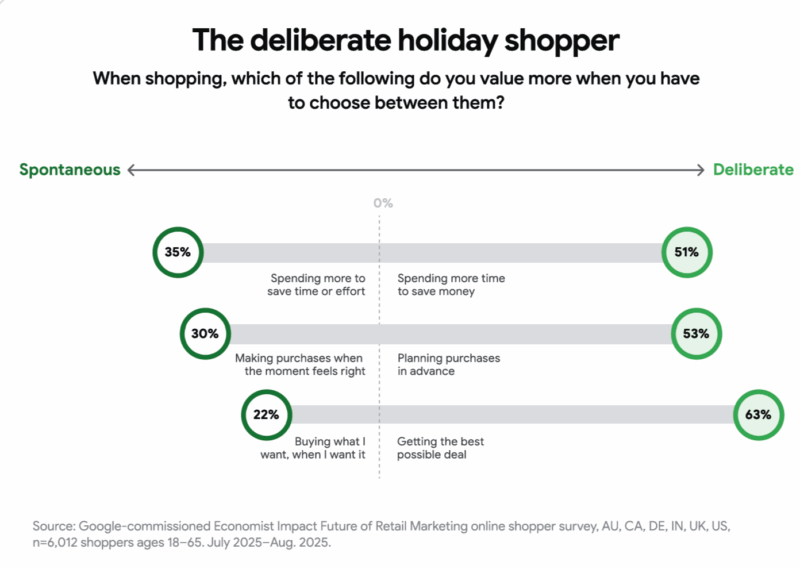
Let’s start with the most compelling chart in the entire report — the “Deliberate Holiday Shopper” research graph. Here are the most relevant statistics:
- 51% of shoppers value spending more time to save money.
- 63% prioritize getting the best deal over impulse buying.
- 53% prefer planning ahead rather than buying “when it feels right.”
In short, the majority of shoppers behave like Competitive or Methodical modalities. This alone is significant. But Google goes further.
- 50% conduct the same amount of pre-purchase research as the rest of the year.
- 38% do even more.
- 61% use 5+ touchpoints in their journey.
- And Google or YouTube or both appear in 86% of all shopper journeys.
When you consider the impact, you’ll see that this isn’t just about caution. It’s also about cognitive style. Competitive and Methodical buyers thrive in environments where they can compare, validate and confirm. Google’s findings show that the holiday season amplifies these tendencies. In other words, they’re still reading your fine print, even as the pressure grows to complete shopping on time.
Dig deeper: Holiday ecommerce spending hits $79.7 billion before Cyber Week even begins
2. Google’s new ‘value equation’ maps to the modalities
Google defines today’s shopper priorities around three pillars (Pages 6–8):
- Right price.
- Product confidence.
- Purchase convenience.
Each of these pillars aligns with a buyer modality.
Right price = Competitive modality
Google reports that nearly half of shoppers actively search for competitive prices and take advantage of major sales events. Thirty-two percent are buying only when a discount appears. This is textbook Competitive behavior: “I want to win the deal.”
Product confidence = Methodical + Humanistic
Methodical buyers crave detail, validation, reviews and long-form content. Humanistic buyers crave trust, human reassurance and social proof.
Google’s findings support both buyers.
- Search is the No. 1 place shoppers go to confirm facts.
- 70% of social media users validate their discoveries on Google.
- YouTube creators are now among the most trusted sources of product insight.
- Eighty % say YouTube helps them make more confident purchasing decisions.
If I had created a behavioral study to define Methodical and Humanistic shopping patterns, it would look almost identical to this.
Purchase convenience = Spontaneous
Spontaneous buyers make fast, intuitive decisions, as long as you give them a smooth path to checkout. Google highlights these factors that Spontaneous shoppers need to say yes in the moment:
- Fast delivery.
- Flexible returns.
- Seamless checkout.
- Personalized relevance.
- Local inventory visibility.
Dig deeper: How to turn holiday shoppers into loyal friends, not one-time buyers
3. Google’s AI ecosystem also reinforces the modalities
Google’s emphasis on AI-powered discovery, creative and optimization (Pages 14–17) supports different modalities automatically:
- Competitive: Dynamic pricing signals, search annotations, deals surfaced directly in Shopping.
- Methodical: Detailed AI Overviews, multimodal search results, structured product data.
- Humanistic: Creator partnerships, authentic video content, review-led discovery.
- Spontaneous: One-click personalization, fast-loading landing pages, frictionless paths.
The subconscious brilliance of Google’s AI enhancements is that they cater to how shoppers think and not just what they search for.
4. Marketers must optimize for cognitive fit, not just channel
The message from Google’s research is unmistakable: Shoppers don’t respond to one-size-fits-all messages. They respond to cognitive fit.
Marketers who design emails, pages, automations and journeys to accommodate all four modalities simultaneously will outperform those who optimize purely for the email channel itself. That means copy must be on point, thoughtful and comprehensive, without filling the page with paragraphs of tiny print. It’s a big job, but your copywriters should be ready for it.
I can hear what you’re thinking: “Kath, how can I put all of this into a single email? Do I have to create four campaigns?” Absolutely not! That would be ridiculous, right? And nobody has time for that now that the starting gun has gone off and the race has begun.
Instead, a simple design and a few well-chosen words can convey the meanings your customers look for. You can devote one campaign to Spontaneous shoppers with content that leads Methodical and Humanistic shoppers to click for more information. And that’s just one example.
Here are more ideas:
- For Competitive buyers: Show value, compare clearly, anchor price and prove the win.
- For Methodical buyers: Provide depth, structured information and offer detail-rich content.
- For Humanistic buyers: Use testimonials, creators, user-generated content and relationship-led copy.
- For Spontaneous buyers: Reduce friction, speed up decisions and remove barriers.
This isn’t personalization, it’s persuasion. It’s grounded in behavioral science, not assumptions.
Dig deeper: How to design holiday promotions that work
The big takeaway: The Four Buyer Modalities aren’t just theory
For years, marketers have sensed these patterns intuitively. Now, Google’s global data confirms them empirically. What we’re seeing isn’t holiday behavior. It’s human behavior amplified when the stakes are higher.
That’s why this framework is so powerful. Whether you’re creating email journeys, landing pages, ads or automations, the Four Buyer Modalities give you a blueprint for designing communications that work with the brain.
Psychology as a competitive advantage
Holiday 2025 might be more cautious and research-driven than in previous years, but beneath the surface lies an incredibly stable truth. People think differently, process differently and decide differently.
Google’s new report shines a light on the patterns and helps you see what you might have overlooked in your past holiday campaigns and what could have given you results that didn’t match your goals or expectations.
When you embrace these modalities, especially in an AI-powered landscape, you can help your customers engage more deeply and come to you first, before checking out your competition. Acknowledging their differences can have these beneficial results.
- Build trust.
- Accelerate decisions.
- Reduce friction.
- Attract high-value customers.
- Create messaging that resonates with everyone, not just the loudest modality in the room or the one that aligns with your personal predilections.
That’s what winning the season really means.
Dig deeper: 7 ways to boost customers’ emotional connection and loyalty with your brand
Fuel up with free marketing insights.
Email:
MktoForms2.loadForm(“https://app-sj02.marketo.com”, “727-ZQE-044”, 16293, function(form) {
// form.onSubmit(function(){
// });
// form.onSuccess(function (values, followUpUrl) {
// });
});
The post 4 takeaways for email marketers from Google’s 2025 holiday report appeared first on MarTech.