

Microsoft is experimenting with a Google-style redesign of Bing search ads, clustering several sponsored links under a single “Sponsored results” heading and introducing a “Hide” control that collapses the full ad group.
Driving the news. Sachin Patel noticed the Bing experiment live and posted screenshots and a video highlighting the updated interface. In this test, only the top sponsored listing is explicitly marked with an ad label, while the remaining ads appear beneath it without individual labels. Searchers can click “Hide” to fold up the entire ad section, and “Show” to expand it again.
How it works. This layout bundles ad units in a way that can further soften the visual line between paid and organic listings. Because the ad disclosure is moved into a single header, each individual sponsored result can resemble a standard search result more closely.
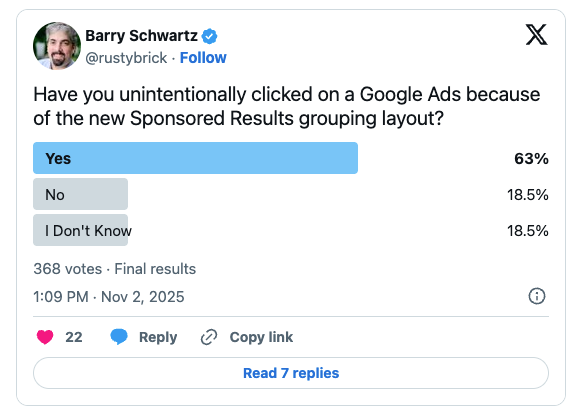
Catch up. Google launched a very similar format about two months ago — and it has already triggered complaints about inadvertent ad clicks. In a poll on X, Barry Schwartz found that 63% of respondents reported accidentally clicking a Google Ads result due to the new grouped presentation.
Bing mirroring this approach suggests a possible broader shift across the search industry in how ad labels and placements are handled.
Why we care. Bing’s consolidated “Sponsored results” experience may raise ad prominence — and likely click-through rates — by allowing ads to blend more seamlessly with organic listings. While the “Hide” button gives users an extra layer of control, the single grouped label could also fuel more unintentional clicks, echoing what advertisers have observed with Google’s redesign and potentially driving up bounce rates.
If Microsoft deploys this change at scale, it could significantly influence campaign outcomes, reporting accuracy and budget efficiency on Bing search.
First seen. Sachin Patel first showcased this grouped layout on X.
The takeaway: If this format rolls out widely, Bing could see higher engagement with ads — whether deliberate or accidental — and renewed debate over how clearly search ads are disclosed. At this stage, the test appears limited, and many users are unable to reproduce it.
What Microsoft are saying. Microsoft Ads Liaison Nava reached out to clarify that this was a test they have decided not to move forward with.