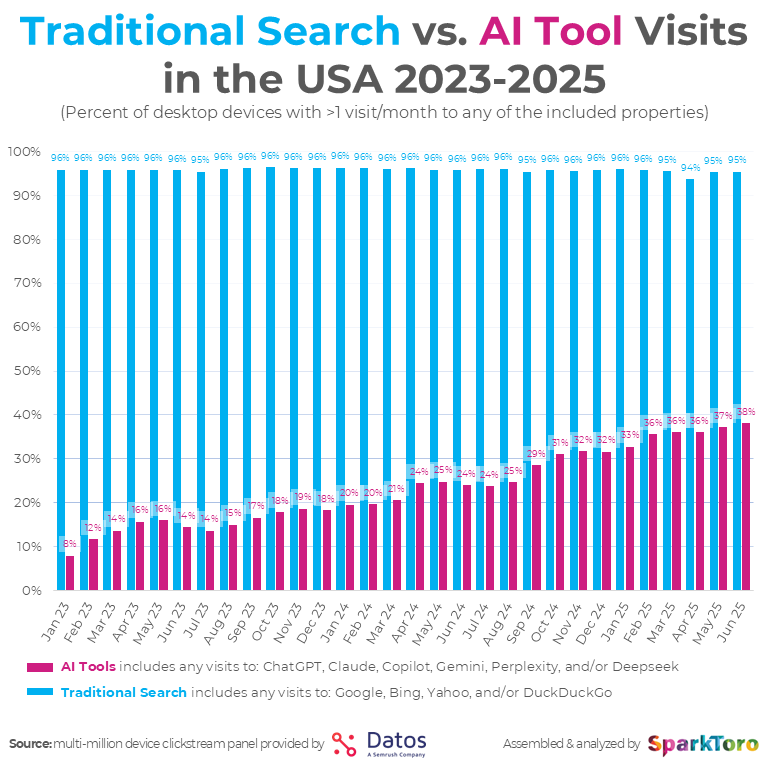
Fair warning: this article may make some people who’ve been loudly promoting AI visibility tools a bit uneasy. After 18 years in the search industry, though, my professional integrity won’t let me just sit on the sidelines. I’m not pushing any hidden agenda. In fact, several of the misconceptions I’m about to address actually work in my favor, both as the co-founder of an AI visibility platform and as someone who sells GEO services. Over the last few months, a lot of statements have been presented as “facts” that simply don’t hold up. Let’s set the record straight. 1. AI search hasn’t killed Google search It’s actually the reverse. It doesn’t matter how many news outlets run clickbait headlines for pageviews, how many VCs hype AI search because they’ve backed certain startups, or how many AI visibility tools spotlight it in their decks to win clients. None of that makes it real. What does? Data. Consider a few examples: Semrush’s latest research, based on more than 260 billion clickstreams, shows that ChatGPT usage has not decreased Google searches. It has, in fact, driven them higher. And before anyone argues that Semrush is biased toward Google, keep in mind that its product suite also includes AI search tracking. Datos’ State of Search Q2 2025 report, produced with Rand Fishkin, CEO of SparkToro, reports Google still commanding a massive 95% market share. Among millions of U.S. devices, over 95% continue to use traditional search engines regularly. So how can ChatGPT’s user base have doubled in the last six months—surpassing 800 million users, according to OpenAI—while Google’s total search volume has…