How Marketing Pro’s Strategy Studio Helps Save You Thousands on Your Marketing Strategy in 2026
Your Marketing Isn’t Broken. Your Focus Is.
Most teams don’t have a marketing problem. They have a prioritization problem dressed up as a performance issue.
Look at your last quarter:
- How many channels did you “test” without committing?
- How many campaigns launched without a clear definition of “win” beyond ROAS or CPL?
- How many internal decks were about “frameworks” vs. actual tradeoffs?
The Strategy Studio concept from MarketingPro is interesting not because it’s another “AI strategy generator,” but because it quietly calls out the real operational failure: most marketing plans are not built around constraints (time, budget, skill, buying cycle). They’re built around wishful thinking and tool FOMO.
For CMOs and performance leads, that’s the signal: if your strategy doesn’t explicitly encode constraints and sequencing, you’re not doing strategy. You’re just choosing tactics in a nicer font.
The Real Problem: Random Tactics Don’t Compound
In practice, here’s what “random tactics” looks like inside a growth team:
- Paid social sprints running without a clear follow-up nurture path.
- SEO content calendars detached from any offer or pipeline target.
- Sales complaining about lead quality while marketing optimizes CTR.
- Brand campaigns launched with no measurement model beyond “awareness.”
The result: effort everywhere, impact nowhere. The team is busy, the dashboards are colorful, and the CFO still thinks marketing is a cost center.
A compounding system, by contrast, has three boring characteristics:
- Sequence: You know what happens after someone clicks, opts in, or ignores you.
- Channel hierarchy: You know which 1-3 channels are primary, and which are support or “parked.”
- Time-bounded focus: You know what the next 30-90 days are for, and what they are not for.
Most teams say they have this. Their calendars and budgets say otherwise.
Strategy Theater vs. Execution-Ready Decisions
The tool takes a swipe at “strategy theater”: frameworks for show, not for work. If you’ve ever spent six weeks on a positioning deck and then shipped nothing, you know the type.
Real operators should be asking one question of any “strategy” artifact: Does this tell my team what to do this week, and what to ignore?
Execution-ready strategy has a few concrete traits:
- Specificity: “Post more on LinkedIn” is not a strategy. “3 founder-led posts per week aimed at X persona, each with a soft CTA into Y lead magnet” is.
- Scope limits: It should explicitly say, “We are not doing TikTok, events, or affiliates this quarter.”
- Cadence: It tells you how often you show up in each chosen channel, not just which channels exist.
- Owner + time cost: It respects that people have finite hours and skills. “Launch a podcast” is not a line item; it’s a job.
What Marketing Pro’s Strategy Studio is trying to do is force these decisions up front by asking about:
- Budget band (under $2k vs $10k+)
- Time available (<3 hours vs 10+ hours vs delegating)
- Experience level (beginner vs advanced)
- Primary objective (leads, sales from existing traffic, launch, nurture, brand)
That’s the part you should steal, even if you never touch the tool: no strategy conversation should continue until those four things are nailed down.

The One Question Most CMOs Skip: “What Can We Actually Execute?”
Marketers consistently design plans for an imaginary team with infinite time and no context switching.
Marketing Pro’s Strategy Studio tool forces a different angle: “Realistically, how much time do you have each week to execute?” That’s not a cute intake field; it’s the core of whether your plan survives contact with reality.
Here’s how this plays out in the wild:
If you have < 3 hours per week
You don’t have a “strategy” problem. You have a capacity problem.
- You can run one main motion: e.g., a single paid channel driving to a simple offer, or a weekly email to a warm list.
- You cannot also “do SEO,” “build a YouTube presence,” and “test webinars.” Those are lies you tell yourself.
For this profile, a good 30-day plan might be:
- Clarify one offer and one audience.
- Set up a simple landing page and basic retargeting.
- Send one value email per week to your existing list with a clear CTA.
That’s it. Anything else is procrastination disguised as ambition.
If you have 3-10 hours per week
Now you can afford a basic funnel, but still not a “full stack” presence.
- One acquisition channel (e.g., Meta or search).
- One nurture channel (email or SMS).
- One core asset (a lead magnet, a mini demo, or a short video sequence).
Your strategy should literally say: “No new channels until we hit X leads/month at Y cost from this one.”
If you have a team (10+ hours or delegation)
Now you can layer. But “layer” doesn’t mean “everything.” It means:
- Primary channel(s) that must perform this quarter.
- Secondary experiments with capped budget and clear kill criteria.
- Brand-building plays that are intentionally decoupled from short-term CAC.
Without this, even a well-resourced team becomes a chaos machine with strong opinions and weak outcomes.
Modern Buyer Reality: Trust, Repetition, Intent
Strategy Studio calls out three things most performance dashboards underweight:
- Trust: People buy from brands they believe will not waste their time or money.
- Repetition: Single-touch conversions are the exception, not the rule.
- Intent: Not all clicks are created equal; some are curiosity, some are pain-driven, some are ready-to-buy.
Operators know this intuitively, but plans often ignore it. For example:
- Running cold traffic directly to a high-ticket sales call without any pre-education.
- Judging channels only by last-click ROAS while ignoring their role in priming demand.
- Expecting a 7-day trial to close customers whose buying cycle is 60-90 days.
A 30-90 day roadmap that respects modern buyer behavior will:
- Define “trust-building” assets (case studies, founder videos, transparent pricing, social proof) and where they show up in the journey.
- Design for multiple touches: retargeting sequences, email drips, remarketing to engagers, not just visitors.
- Segment by intent: different messaging for “problem-aware” vs “solution-aware” vs “ready to switch.”
This is where the “channel focus” idea matters: if you only have the budget and time to properly build trust and repetition in one or two channels, pretending you’re “omnichannel” just guarantees shallow presence everywhere.
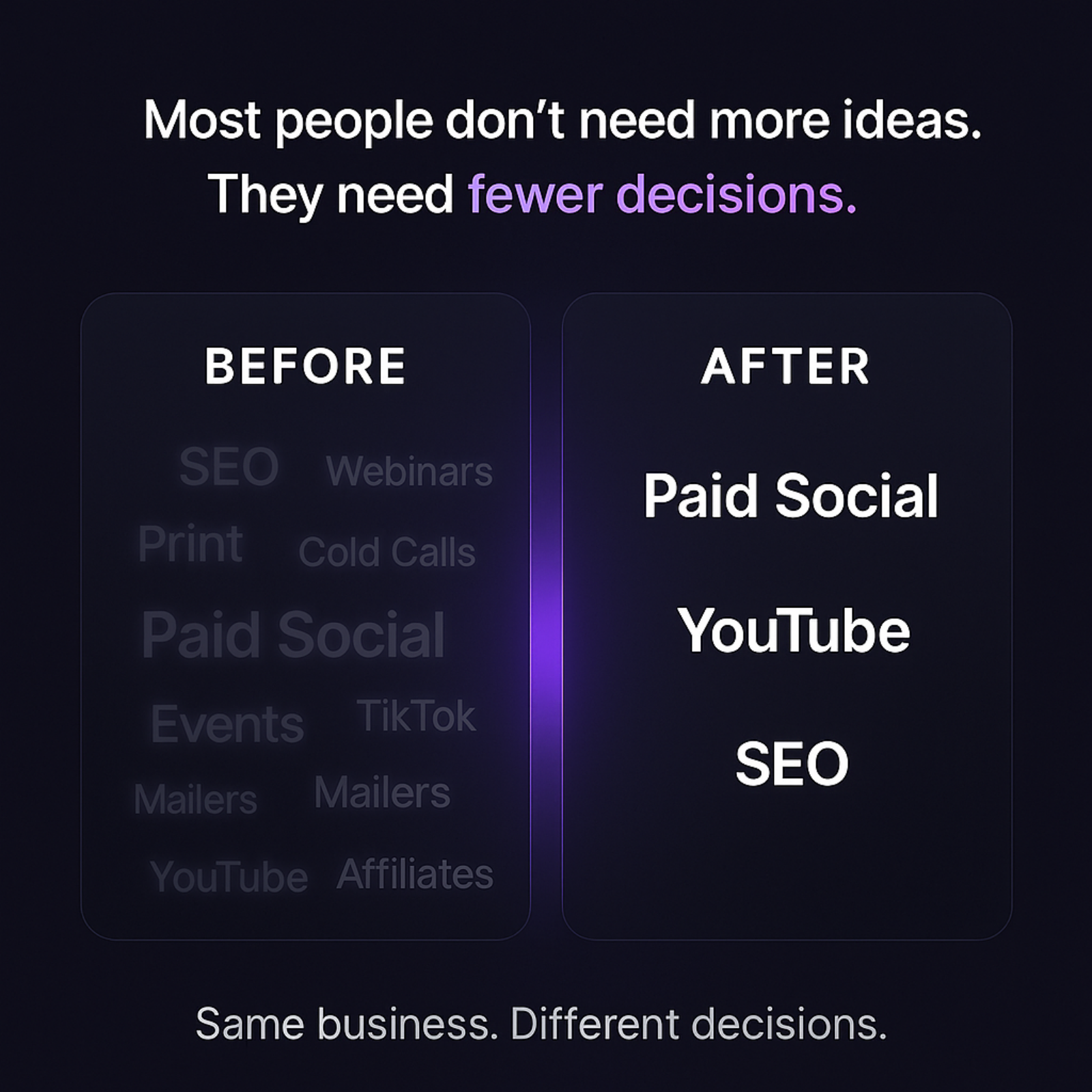
Channel Focus: Pick 1-3, Put the Rest in the Parking Lot
“You’ll know exactly which 1-3 channels matter right now – and which to ignore.” That’s the uncomfortable part most leadership teams avoid: choosing what to ignore.
In practice, a focused channel strategy looks like this:
- Primary channel: 60-80% of budget and attention. Example: Google Search for high-intent B2B leads.
- Secondary support: 20-30%. Example: LinkedIn organic + retargeting to educate and nurture.
- Parking lot: Everything else you’ll revisit in 90 days with clear criteria (“We test YouTube only after we hit 200 SQLs/month from search.”).
What most teams do instead:
- Spread $5-10k/month across 5-7 channels.
- Hit no meaningful frequency, build no real muscle, and declare “nothing works.”
If you want compounding returns, you need temporal focus: commit to one acquisition engine long enough to actually optimize it (creative, offers, landing pages, follow-up) before chasing the next shiny thing.
Objectives That Actually Direct Strategy
The intake flow forces a choice of primary objective:
- Generate more qualified leads
- Increase sales from existing traffic / list
- Launch a new offer or product
- Keep pipeline warm / nurture audience
- Strengthen brand and awareness
- “I’m not totally sure yet”
Most marketing plans quietly try to do all of these at once. That’s how you end up with a Frankenstein funnel: half lead gen, half nurture, half brand (yes, that’s three halves).
Here’s how a serious operator would translate each objective into a 30-90 day focus:
1. Generate more qualified leads
- Prioritize high-intent channels (search, partner referrals, outbound with tight ICP).
- Optimize qualification gates: forms, quizzes, or offers that repel bad fits.
- Align sales follow-up SLAs and scripts to the new lead source.
2. Increase sales from existing traffic / list
- Audit existing paths: where do people drop off from site to purchase?
- Introduce clearer offers, bundles, or time-bound promotions to warm audiences.
- Improve email flows, cart recovery, and post-click experience before buying more traffic.
3. Launch a new offer or product
- Borrow trust from existing channels and audiences first.
- Use 30-90 days to validate positioning and pricing before scaling spend.
- Set “learning goals” (message, audience, price) alongside revenue goals.
4. Keep pipeline warm / nurture audience
- Commit to a consistent content or email cadence (weekly is usually enough).
- Map nurture to buying stages, not just “newsletter blasts.”
- Align sales touchpoints with marketing content (e.g., AE-sent content that matches campaigns).
5. Strengthen brand and awareness
- Define specific audiences and markets; “everyone” is not an awareness strategy.
- Pick 1-2 brand-building plays (video series, podcast, flagship content) and stick with them.
- Set leading indicators (search volume, direct traffic, branded queries, recall in surveys), not just “vibes.”
If your current quarterly plan doesn’t force this level of objective clarity, that’s the first fix – not a new tool.
Fear, Risk, and Why Teams Default to Busywork
One of the more honest parts of the Strategy Studio: it asks, “What secretly worries you the most?” with options like:
- Wasting money and getting nothing
- Looking dumb / not knowing what to do
- Being spread too thin
- Not getting results fast enough
Those fears quietly drive a lot of bad marketing decisions:
- Fear of wasting money → under-investing in a single channel long enough to see results; constant micro-tests with no power.
- Fear of looking dumb → hiding behind buzzwords and frameworks instead of making clear bets and owning them.
- Fear of being spread too thin → ironically, saying yes to everything so no one can say you “missed something.”
- Fear of slow results → chasing hacks and arbitrage plays instead of building durable demand.
Good strategy doesn’t eliminate fear, but it gives it a job: “Here are the 2-3 bets we’re making for the next 90 days. Here’s how we’ll know if they’re working. Here’s what we’re not doing until then.”
How to Steal the Strategy Studio Playbook Without Using the Tool
If you run a team or own a P&L, you don’t need another shiny product. You need a sharper way to decide what your team does next. Here’s a simple way to adapt the underlying ideas:
- Start every planning cycle with constraints
Write down: budget band, time available per person, skill level, and your primary objective for the next 30-90 days. No tactics until this is agreed. - Force a channel cap
Choose 1-3 primary channels and explicitly list the ones you’re ignoring for now. Put a date on when you’ll revisit that list. - Design for modern buyers
For each chosen channel, define: trust assets, repetition plan (how many touches, over how long), and how you’ll capture and respond to intent. - Turn “strategy” into a weekly checklist
For each motion, define: frequency (how often), owner (who), and minimum standard (what “done” looks like). If it doesn’t fit in the calendar, it’s not in the strategy. - Make fear explicit
Ask your team the “secret worry” question. Bake the answers into your plan: set test budgets, define kill criteria, and agree on what “reasonable speed” looks like.
Most teams don’t need more hustle. They need fewer, sharper bets that respect how people actually buy and how their own team actually works. The tools will keep changing. The constraint-based, focus-first way of thinking is the part worth keeping.
To Try Marketing Pro’s Strategy Studio for free, click here.
read next