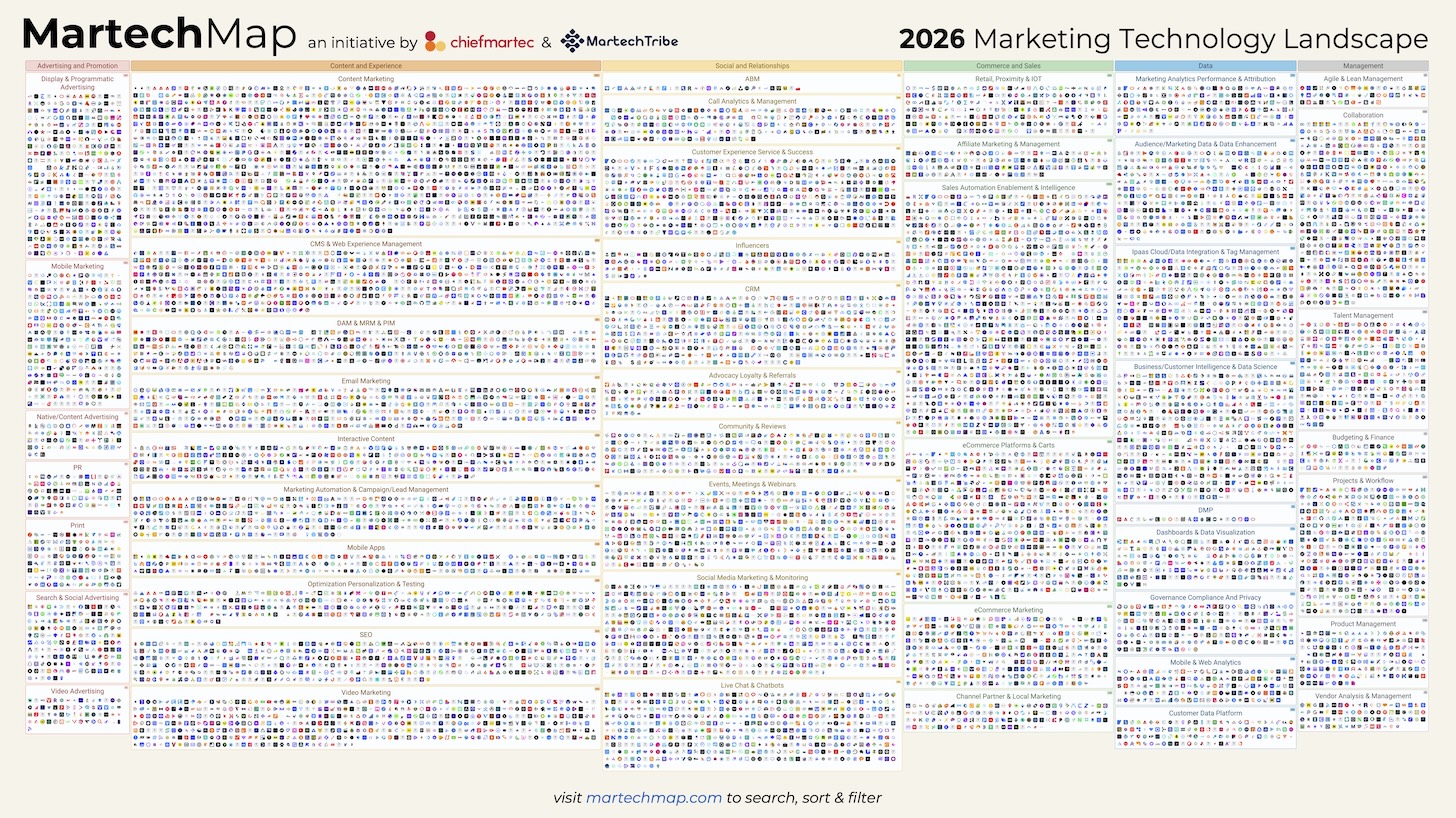
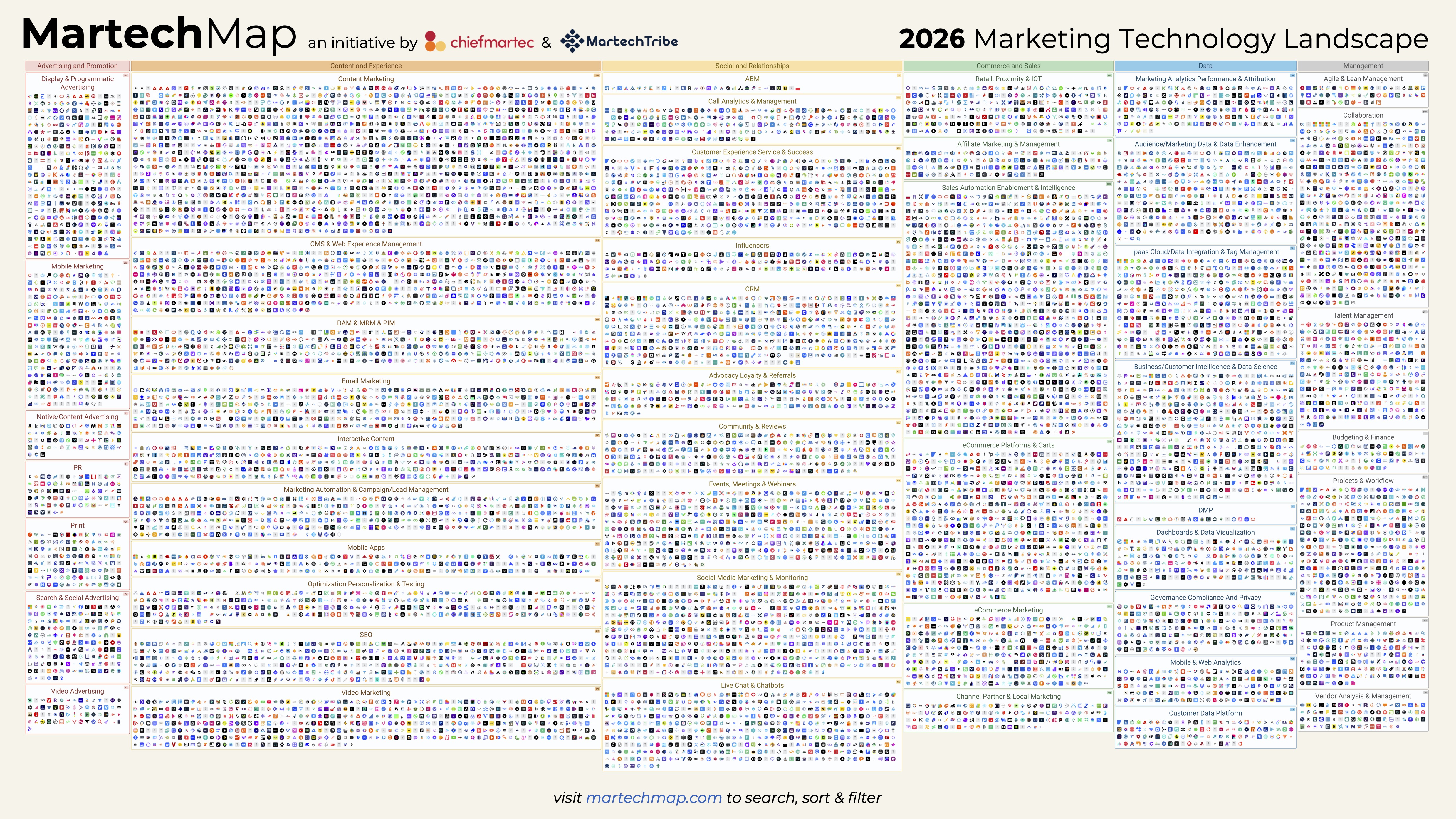
tl;dr The martech landscape essentially stopped expanding this year, inching up just 0.79% to 15,505 products. After 15 years of near-constant growth, we may finally be at peak martech — or at least on a plateau.
Beneath that flat top-line number, however, the market is in intense motion: 1,488 products were added and 1,367 were removed. The AI surge in content marketing is already consolidating. The real acceleration is now in CMS, ecommerce, analytics, integration, governance, and AEO/GEO. We unpack all of this in the new State of Martech 2026 report — free, with no gate.
For most of the last 15 years, the annual martech landscape followed a very familiar storyline.
More.
More products. More logos. More categories. More existential anxiety for anyone trying to cram it all onto a single slide. The question each year wasn’t whether the landscape would grow, but by how much.
Some years it expanded massively. Other years it grew by a merely absurd amount. Even when commentators confidently proclaimed that consolidation had finally arrived, the landscape shifted into yet another gear. Martech, like life in Jurassic Park, uh, found a way.
This year breaks that pattern.
Which brings us to the release of the 2026 Marketing Technology Landscape, now listing 15,505 products. It did grow — technically. Up from 15,384 last year, the landscape gained a net of just 121 products. That’s only 0.79% growth — for all practical purposes, flat.
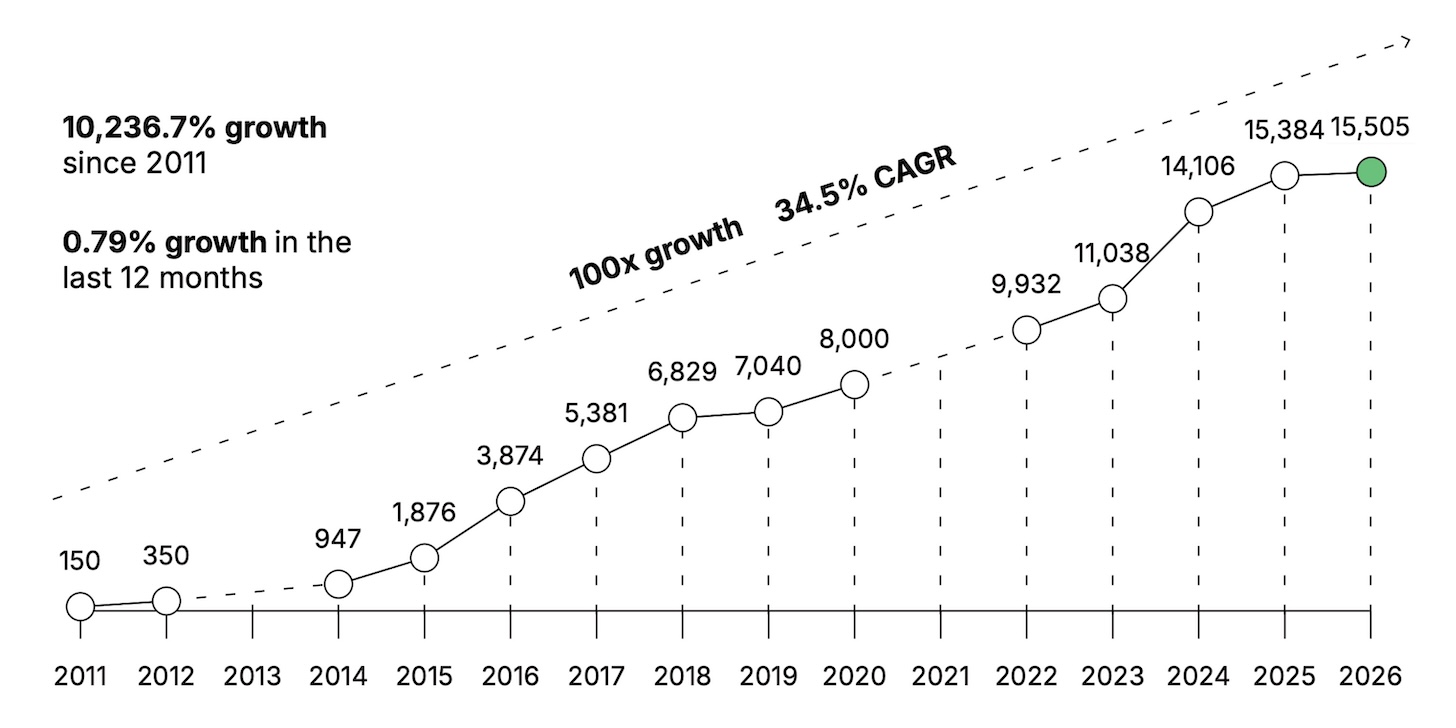
After expanding from 150 products in 2011 to more than 15,000 today, we may have finally reached peak martech.
Yes, that phrase has been used before. Many times. Often by people who then watched another thousand logos appear the following year. But this time, the data at least allows us to seriously consider the idea.
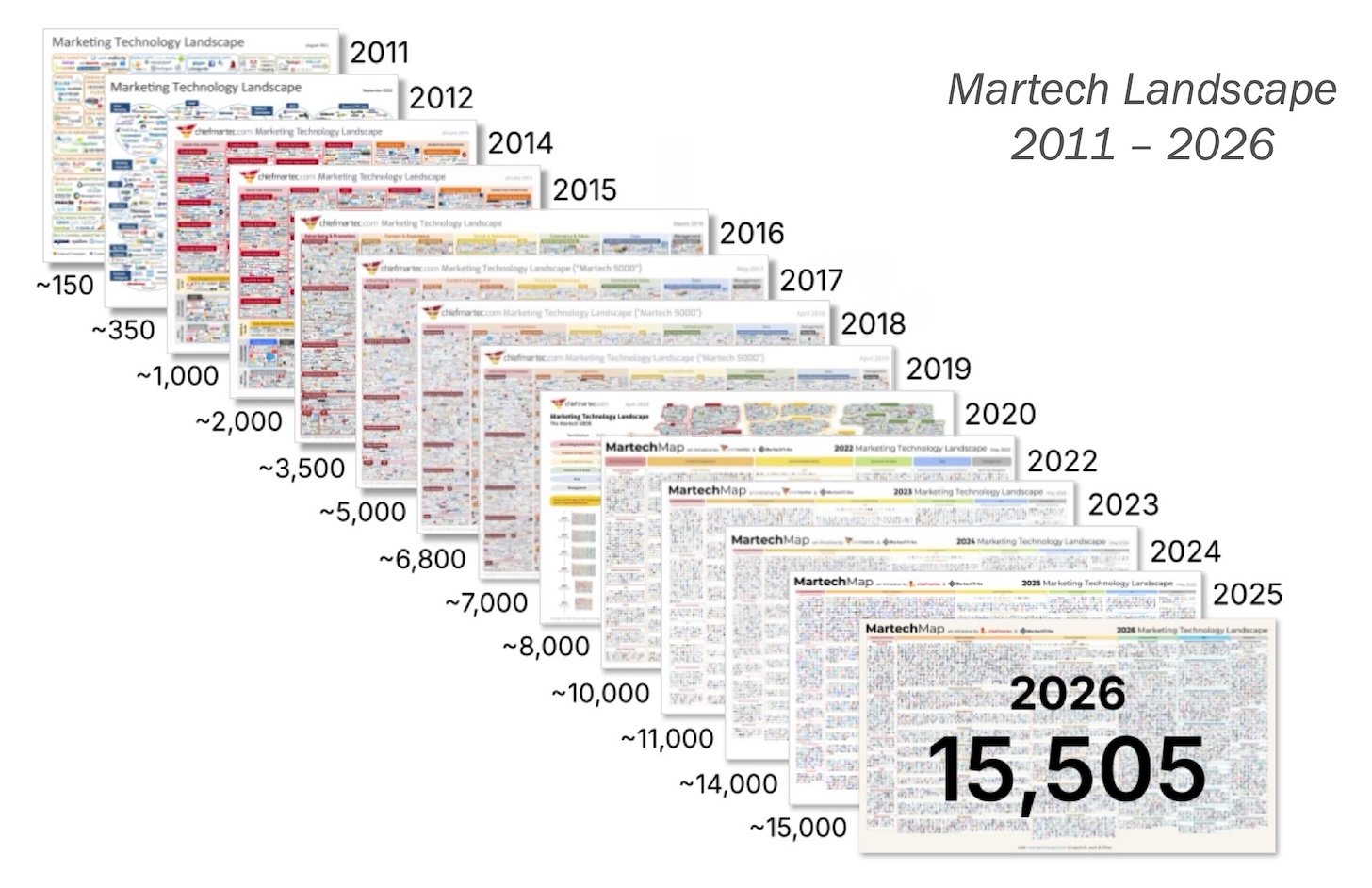
Before you assume the martech market simply stalled, it’s worth examining the underlying movement.
Last year, 2,489 products were added to the landscape. This year, that number fell to 1,488 — a 40% drop in new arrivals. Meanwhile, removals climbed from 1,211 to 1,367 — an increase of 13%.
So the reason the total barely changed isn’t that the market went quiet. It’s that new entries and exits almost offset each other.
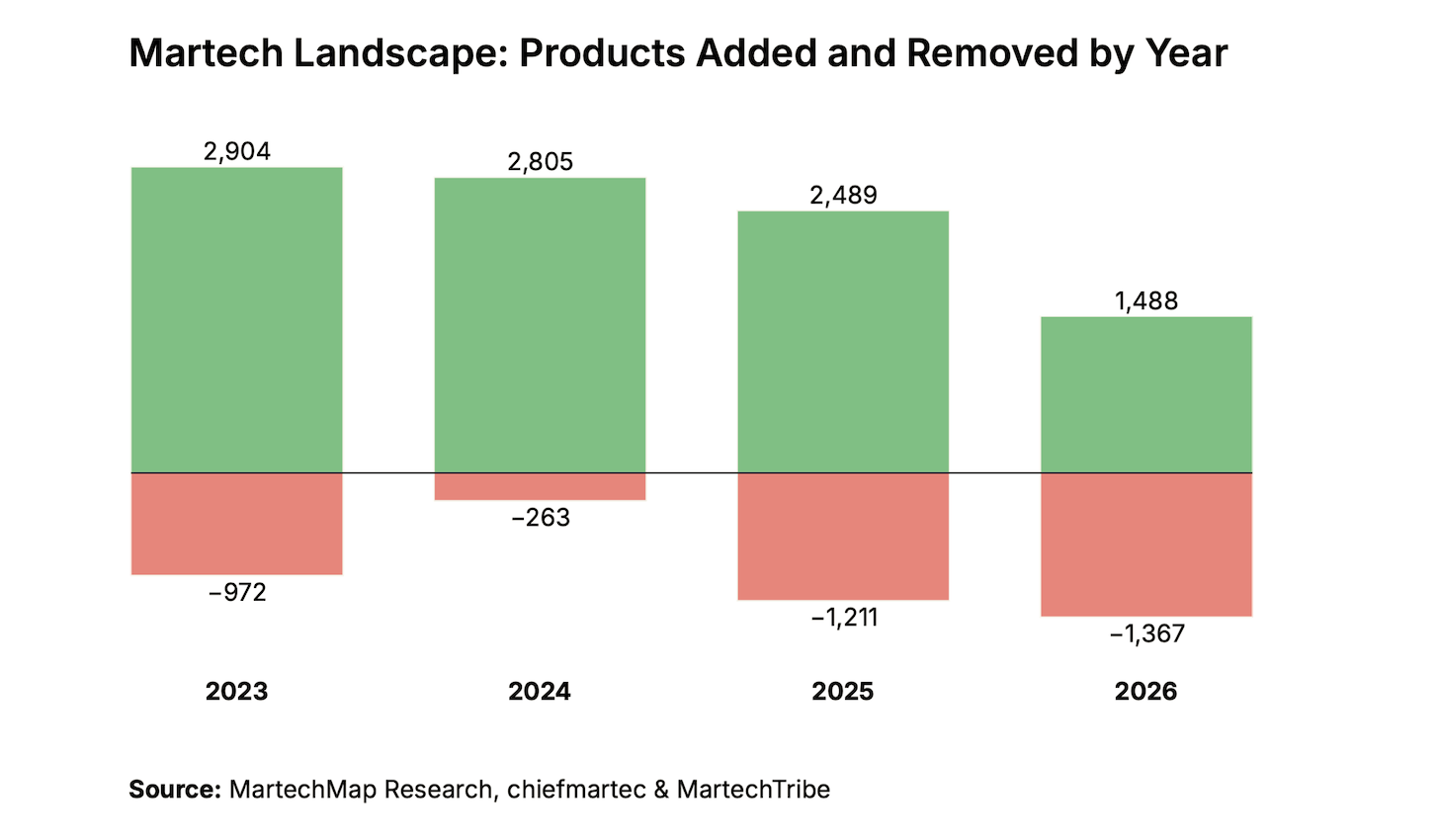
The biggest share of exits came from the 2010–2019 SaaS boom, representing 51.7% of this year’s removals. So this isn’t just a cleanup of tiny AI wrappers spun up during the first ChatGPT rush. A significant slice of the first major SaaS martech generation is now being retired.
Departures were also skewed toward smaller vendors. By revenue, 45.5% of removed products were in the $1M–$10M band. By headcount, 41.2% had 1–10 employees and 38.7% had 11–50.
These firms achieved enough traction to become legitimate businesses, but not enough to become indispensable. And in a world where incumbents are bundling AI from the top, AI-native challengers are attacking from the bottom, and buyers are rationalizing their stacks, the middle is under pressure.
Martech is a river, not a lake
If this is peak martech, it doesn’t imply innovation has stopped. This year’s growth narrative is actually concentrated in some very established-sounding segments:
CMS & Web Experience Management expanded 21.4%, from 504 to 612 products.
Ecommerce Platforms & Carts increased 19.9%, from 547 to 656.
These aren’t brand-new categories, yet they’re among the fastest-growing areas on the landscape — largely because of AI.
For roughly 20 years, websites were designed mainly for two audiences: humans and search crawlers.
Now a third audience is emerging: machines acting on behalf of humans — AI search assistants, agentic browsers, shopping agents, procurement bots, answer engines. They may not “browse” your site at all. They want to extract, compare, summarize, validate, and execute.
The long-term story is still remarkable: the martech landscape has expanded more than 100X since 2011 — 10,236.7%, if you like your stats with extra digits.
And this isn’t only about serving external AI systems. AI is also transforming on-site experiences for human visitors. Marketers are rolling out their own agents as guides, advisors, configurators, concierges, and sales assistants — all powered by product data, content, customer history, pricing, policies, inventory, reviews, and brand standards.
That’s where context engineering becomes pivotal. The quality of these experiences depends less on the model alone and more on the context the agent can tap, the tools it can invoke, the actions it’s allowed to take, and the guardrails that constrain it.
Ecommerce is following the same script. Clean, structured, machine-readable catalog data helps external AI systems interpret your products — and also fuels richer on-site journeys: AI concierges that compare items, explain trade-offs, build bundles, answer compatibility questions, and steer customers through complex choices.
The future of the web may feel less like clicking through pages and more like collaborating with a well-briefed expert.
The rest of the fastest-growing subcategories echo this same transition.
Mobile & Web Analytics rose 11.3%. Call Analytics climbed 8.9%. As more of the customer journey moves into AI-mediated interactions, marketers are racing to instrument the parts they can still observe.
iPaaS/Data Integration grew 8.0%. Governance, Compliance & Privacy increased 7.1%. When agents can operate across systems, the connective tissue — and the policies around it — become far more important.
Marketing Automation & Campaign/Lead Management expanded 5.9%. Yes, that category — the one many have labeled “mature” for years. It turns out that when AI reshapes orchestration, old categories can get fresh storylines.
The signal is clear: AI isn’t just spawning new categories. It’s re-energizing established ones.
Deeper insights in the State of Martech 2026
What you’ve read here is only a slice of what’s in the full State of Martech 2026 report, which you can download free, with no form fill.
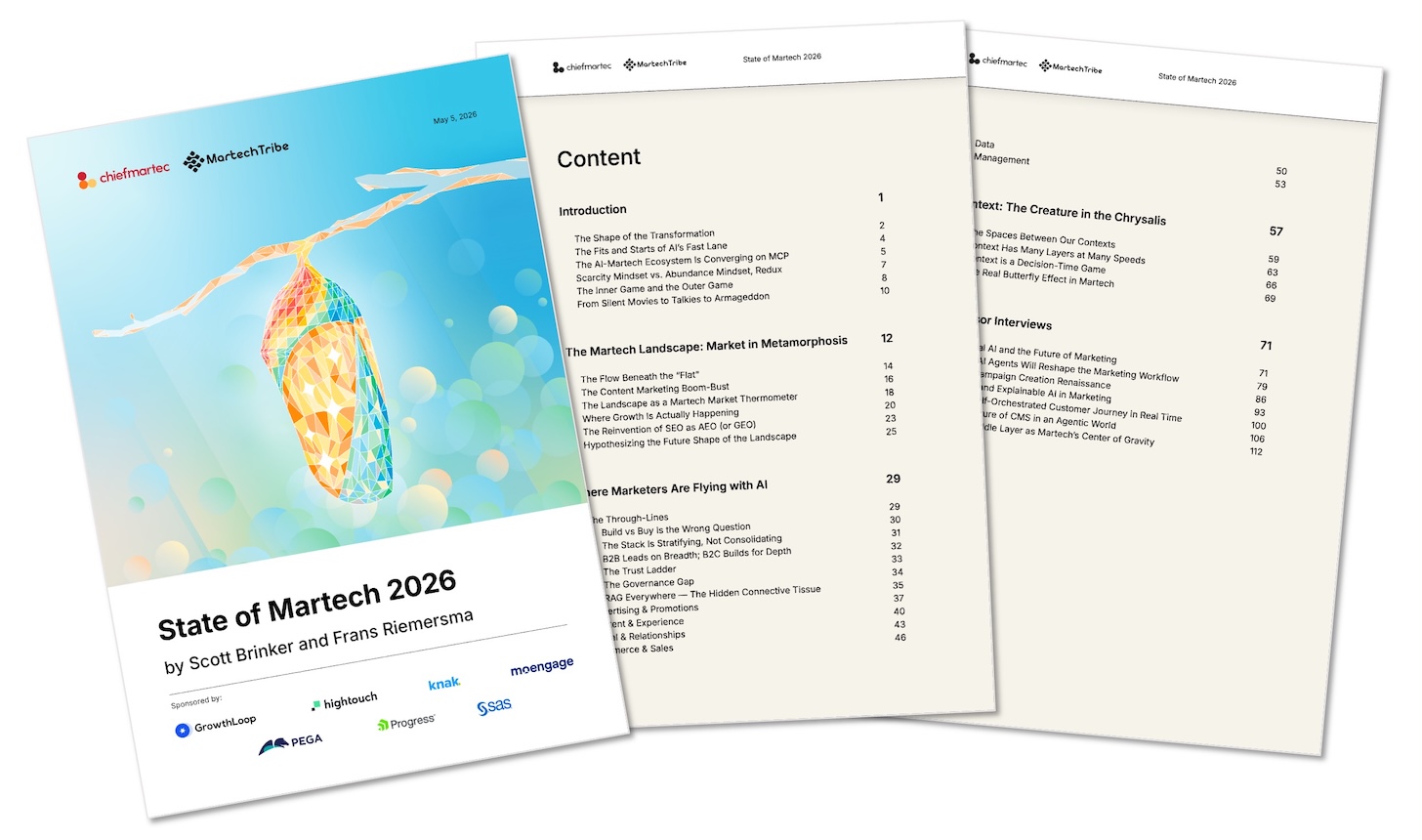
The report explores the full 2026 Marketing Technology Landscape, our analysis of trends across 15,000+ martech products, an in-depth look at 70 AI marketing use cases, and a chapter on context as the connective tissue of AI-driven marketing.
We’re grateful to GrowthLoop, Hightouch, Knak, MoEngage, Pega, Progress, and SAS for sponsoring this research and enabling us to share the report openly.
So yes, we may finally be at peak martech. But the calm surface hides a lot of current.
Download a hi-res, clickable PDF of the complete martech landscape
Visit MartechMap.com to zoom, search, and filter the interactive version