We’ve refreshed our coverage of bulk email restrictions to add information about DMARC enhancements and new deliverability insights in Google Postmaster Tools. You can also listen to an AI-generated audio summary of the bulk email rules from Google, Yahoo, and Microsoft. As of Feb. 1, 2024, Google and Yahoo began enforcing updated standards for high-volume email senders. These rules primarily address three key areas: authentication of outgoing messages, spam complaint rates, and providing a simple way for recipients to unsubscribe.
In an early-October 2023 announcement, Google described bulk senders as “those who send more than 5,000 messages to Gmail addresses in one day,” a definition that quickly drew the attention of email marketers across both B2B and B2C sectors. Google indicated that bulk senders who don’t comply with the requirements will initially see temporary errors (with specific error codes) on a portion of their non-compliant traffic. These soft errors are intended to help senders pinpoint which messages fail to meet the new standards and give them time to correct the underlying issues. Beginning in April 2024, Google moved from temporary errors to outright rejections.
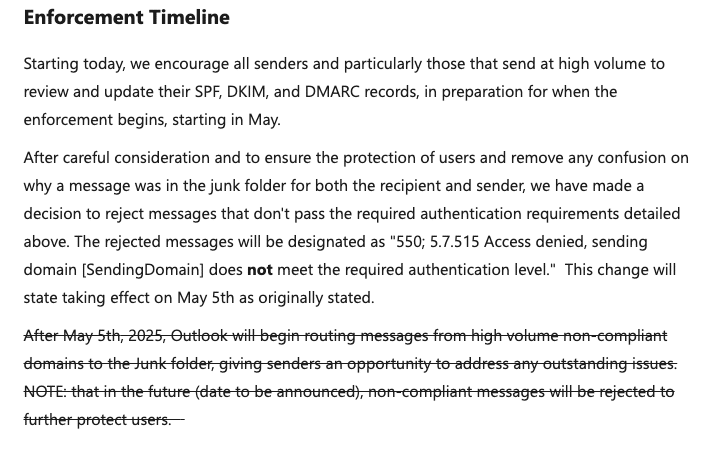
According to Google: In April 2024, we’ll start rejecting a percentage of non-compliant email traffic, and we’ll gradually increase the rejection rate. For example, if 75% of a sender’s traffic meets our requirements, we’ll start rejecting a percentage of the remaining 25% of traffic that isn’t compliant. See the Google email sender guidelines for more details. In April 2025, Microsoft announced its own policies for high-volume senders, which closely align with the restrictions introduced by Google and Yahoo. Microsoft’s rules apply to bulk senders (sending…