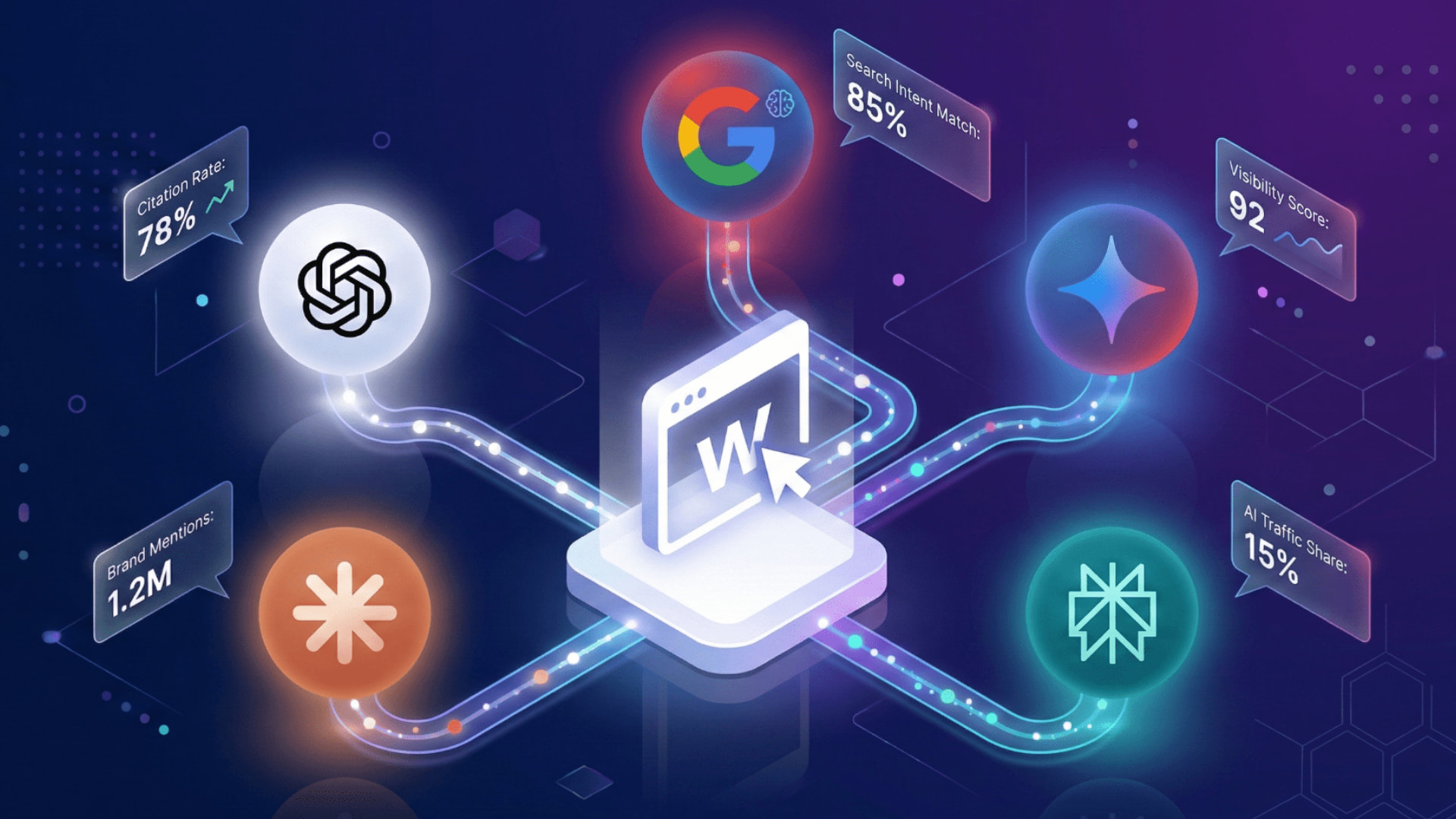
With generative AI tools attracting hundreds of millions of users and AI-enhanced results appearing in more search experiences, the way people discover brands is changing. Traditional SEO metrics alone no longer capture this full picture.
Welcome to the era of generative engine optimization (GEO). If you aren’t tracking your brand’s visibility across AI search engines, you’re flying blind.
The AI search revolution is already here
The numbers are striking:
- 58% of consumers have replaced traditional search engines with generative AI tools for product recommendations, according to Capgemini research.
- Traditional organic search traffic is expected to decline by 50% by 2028, per Gartner.
- ChatGPT referrals now drive 10% of its new user sign-ups – up from less than 1% just six months prior, Vercel reported.
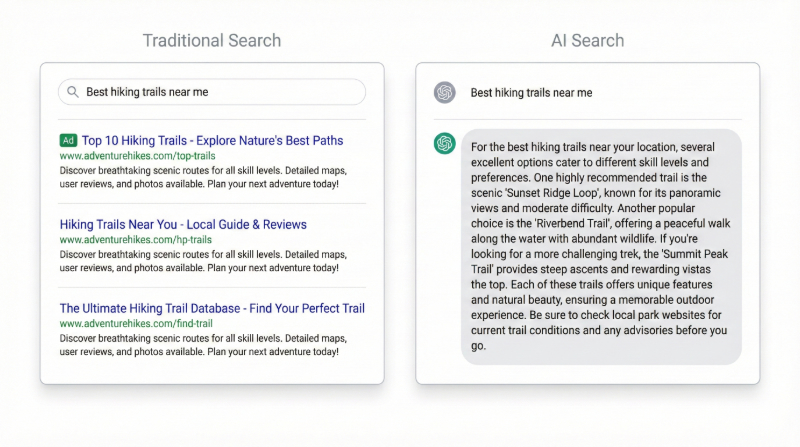
Unlike traditional search, where you fight for spots on a results page, AI search engines like ChatGPT, Claude, Gemini, and Perplexity deliver direct answers and cite only a few sources. If your brand isn’t mentioned, you may be invisible to users who rely on AI-generated answers.
This is where a GEO rank tracker becomes essential. Tools like Geoptie’s free GEO Rank Tracker show you exactly where your brand stands across major AI platforms.
What is a GEO rank tracker?
A GEO rank tracker measures how often your brand appears, gets cited, and is recommended across AI-powered search platforms. Unlike traditional rank trackers that focus on your position on search engine results pages, GEO tracking zeroes in on these metrics that actually matter in the AI era:
- Brand mention frequency: How often AI engines reference your brand when answering relevant queries.
- Citation rates: Whether your website appears as a source in AI-generated responses.
- Share of voice: Your visibility compared to competitors within AI answers.
- Cross-platform performance: Your visibility across ChatGPT, Claude, Gemini, Perplexity, and Google AI Overviews.
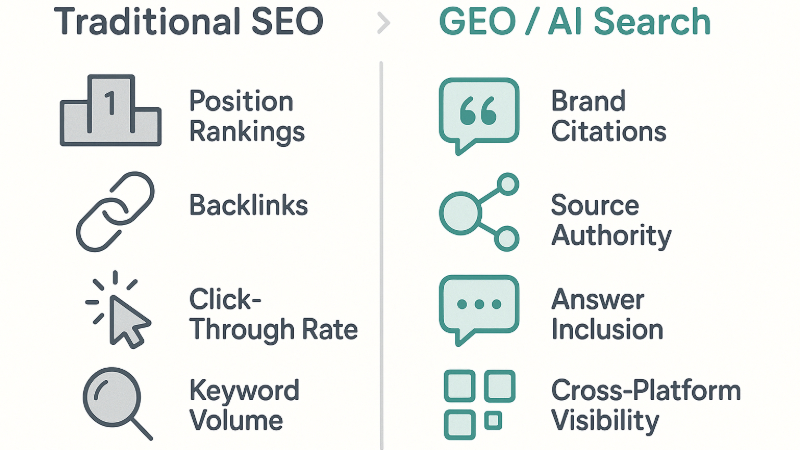
In traditional SEO, you optimize for where you appear in a list of search results. In GEO, you optimize for whether AI mentions you at all – and what it says when it does. Geoptie helps brands navigate this shift with a full suite of GEO tools.
Why traditional rank tracking falls short
If you still rely on traditional rank tracking tools, you’re measuring yesterday’s game:
- Different discovery mechanisms: Traditional search engines rank pages using a variety of signals, such as backlinks and keywords. AI engines use retrieval-augmented generation (RAG) to pull from multiple sources and synthesize a single answer.
- Answers over clicks: Users are increasingly relying on AI-generated summaries without ever clicking through. A top-ranking page means nothing if AI doesn’t cite it.
- Variable outputs: AI responses shift from query to query. Tracking them requires consistent monitoring and statistical sampling – exactly what Geoptie’s GEO Rank Tracker is built to handle.
- Multi-platform fragmentation: Your brand might show up in ChatGPT yet be invisible in Perplexity. Each AI platform pulls from different data sources and uses its own retrieval methods.
Key metrics every GEO rank tracker should measure
When evaluating your AI search visibility, focus on these core metrics:
- Citation Frequency: How often your site or content gets cited in AI-generated answers. This is the GEO version of earning a backlink – only it directly shapes what millions of users see.
- Brand Visibility Score: A composite metric showing how prominently your brand appears across AI platforms for your target keywords and topics. High visibility means the AI reliably recognizes and references your brand as relevant.
- AI Share of Voice: Your brand’s mention rate compared to competitors in AI-generated answers. If a competitor shows up in 60% of relevant responses and you appear in only 15%, that gap represents a lost opportunity.
- Sentiment and Positioning: AI platforms don’t just mention brands – they characterize them. Understanding how AI describes your business helps identify perception gaps and optimization opportunities.
- Geographic Performance: AI responses can vary by location. A GEO rank tracker with location-based analysis shows how your visibility differs across markets.
How to track your brand’s AI search rankings
Getting started with GEO tracking requires a systematic approach:
Step 1: Identify your core prompts
Start by mapping the questions your potential customers ask at each stage of their journey. Unlike keyword research, prompt research focuses on the natural language questions people type into AI chatbots.
Step 2: Monitor across all major platforms
AI search is fragmented across multiple platforms, each with different strengths and user bases:
- ChatGPT: The dominant player with 800+ million weekly users.
- Google AI Overviews: Appearing on billions of Google searches.
- Claude: Growing rapidly with integration into Safari.
- Perplexity: Gaining traction for research-oriented queries.
- Gemini: Google’s standalone AI assistant is growing fast.
Step 3: Track by location and language
AI responses vary by geography. If you serve multiple markets, track your visibility in each target country.
Step 4: Benchmark against competitors
Understanding your share of voice against competitors shows whether you’re gaining or losing ground in AI search visibility.
For brands looking to get started fast, Geoptie’s free GEO Rank Tracker offers an easy entry point. Add your domain, target country, and keyword, and the tool shows your rankings across Gemini, ChatGPT, Claude, and Perplexity – giving you an instant snapshot of your AI search presence.

Interpreting your GEO Rank Tracker results
Understanding what your AI visibility data means is crucial for taking action:
High visibility, low citations
If AI platforms often mention your brand but rarely cite your site, your content may not have the structured, authoritative format AI engines prefer. Strengthen it with statistics, expert quotes, and clear source attribution.
Strong on one platform, weak on others
Each AI platform draws from different data sources. If you’re visible in ChatGPT but absent in Perplexity, investigate which sources each platform favors and adjust your distribution strategy to match.
Declining visibility over time
AI systems continually retrain on new content. If your visibility slips, competitors may be creating more citation-worthy material, or your content may simply be getting stale. Regular updates and fresh publishing are essential.
Competitor visibility gaps
When you spot queries where competitors appear, but you don’t, you’ve found optimization opportunities. Analyze what makes their content citation-worthy, then create competing assets.
From tracking to optimization: Building your GEO strategy
A GEO rank tracker gives you the data, but turning those insights into stronger visibility takes strategic action:
- Expand your semantic footprint: Cover your core topics thoroughly, including adjacent concepts and the related questions users are likely to ask.
- Increase fact density: AI platforms prefer content packed with statistics and verifiable details. Research from Princeton University, Georgia Tech, and the Allen Institute for AI suggested that adding citations and quotes boosted AI visibility by more than 40%.
- Optimize for structure: Use clear headers, TL;DR summaries, and FAQ sections. AI engines often pull structured content directly into their answers.
- Build entity authority: Keep your brand’s information consistent across trusted, authoritative sources that AI platforms rely on.
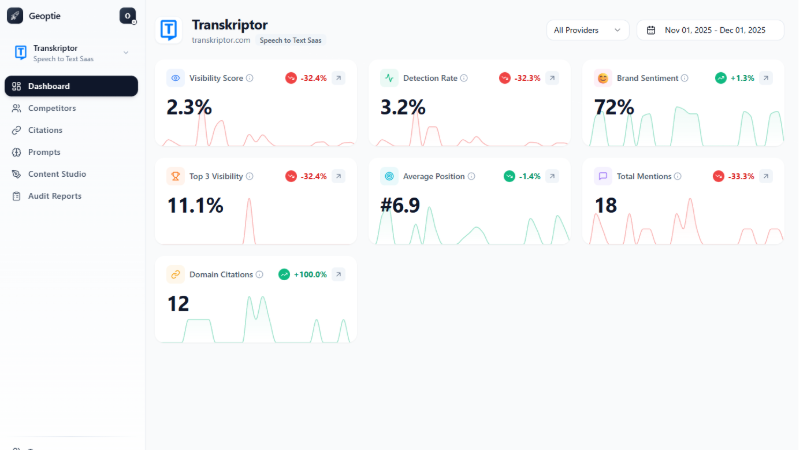
For comprehensive AI search optimization beyond rank tracking, Geoptie’s GEO dashboard offers tools for content analysis, competitive intelligence, technical GEO audits, and ongoing performance monitoring.
The cost of ignoring GEO tracking
The shift to AI search is already here. Brands that ignore their AI visibility risk:
- Losing discovery opportunities as more users rely on AI for recommendations.
- Falling behind competitors who are already building their AI visibility.
- Misallocating resources without knowing whether content investments are paying off.
- Missing brand-perception blind spots in how AI describes and positions them.
Getting started today
The barrier to entry for GEO tracking is lower than you might expect. Here’s a simple plan to get started:
- Run an initial visibility check: Use a free tool like Geoptie’s GEO Rank Tracker to see where you stand across major AI platforms.
- Document your baseline: Record your mention rates, citation frequencies, and competitor comparisons.
- Identify quick wins: Look for queries where you’re close to visibility or where small content improvements could earn citations.
- Establish ongoing monitoring: AI visibility changes faster than traditional rankings. Geoptie’s comprehensive dashboard helps you spot trends early.
- Integrate GEO into your broader strategy: The strongest approach pairs traditional SEO with GEO.

The future of AI search visibility
We’re still in the early days of GEO. Brands that start understanding and optimizing for AI search now will gain advantages that compound over time.
Key trends to watch:
- Multimodal search: AI platforms are starting to process images, voice, and video alongside text.
- Real-time integration: AI systems are connecting to live data sources for fresher, more accurate answers.
- Platform fragmentation: More AI search options are emerging and competing for user attention.
Your visibility in AI-generated answers will increasingly determine whether customers discover your brand. A reliable GEO rank tracker is becoming core infrastructure for modern marketing.
Key takeaways
- Traditional rank tracking doesn’t capture AI search visibility. Dedicated GEO tools like Geoptie are essential.
- Core GEO metrics include citation frequency, brand visibility score, AI share of voice, and geographic performance
- AI search varies by platform, so meaningful tracking requires monitoring ChatGPT, Claude, Gemini, and Perplexity.
- GEO data fuels smarter optimization – expanding your semantic footprint, increasing fact density, and building entity authority.
- Start with Geoptie’s free GEO Rank Tracker and scale to the full GEO dashboard for comprehensive optimization