
November pushed the industry further into AI-shaped discovery. Search behaviors shifted. Platforms tightened control. Visibility started depending less on who publishes most and more on who earns trust across the ecosystem.
AI summaries reached Google Discover. ChatGPT released a browser. TikTok exposed true attribution paths. Meta refined placements. Google rolled out guardrails for AI-written ads. Social platforms changed how your data trains models. Streaming dominated households, and schema picked up a new strategic role.
Here’s what mattered most and how to stay ahead.
Key Takeaways
• AI is rewriting the click path. Google Discover summaries and AI Overviews are reducing CTRs across categories.
• Cross-channel influence is becoming measurable. TikTok attribution now shows how much value standard reporting misses.
• Visibility depends on authority across ecosystems, not just your site. LLMs pull from places brands often ignore.
• Platforms are tightening data controls and usage rules. Expect stricter compliance requirements across ads and content.
• Structured data has moved from “SEO extra” to critical infrastructure for AI-driven search.
Search & AI Evolution
AI is now shaping what users see before they click and in many cases, removing the need to click at all.
AI summaries hit Google Discover
Google added AI-generated recaps to Discover for news and sports stories. Users now get context from summaries instead of visiting publisher sites.
Our POV: Discover has been one of the few remaining high-intent traffic drivers untouched by AI. That buffer is gone. Zero-click consumption will rise.
What to do next: Track Discover CTR in Analytics. Refresh headline structure and imagery to compete with summaries. Expand content distribution beyond traditional articles, since Discover now surfaces YouTube, X, and other formats.
ChatGPT releases an AI-powered browser
ChatGPT Atlas launched with built-in summarization, product comparison, agent actions, and persistent memory settings.
Our POV: The browser itself isn’t the threat. The shift in user behavior is. People will expect AI to interpret pages for them, not just display them.
What to do next: Strengthen structured data. Audit category and product pages for clarity. Start monitoring brand visibility inside AI-driven search using LLM-aware tools.
AI Overviews drive a drop in search CTRs
A new study shows that when AI Overviews appear, both organic and paid clicks fall sharply. They currently trigger for about fifteen percent of queries, most of them high-volume informational searches.
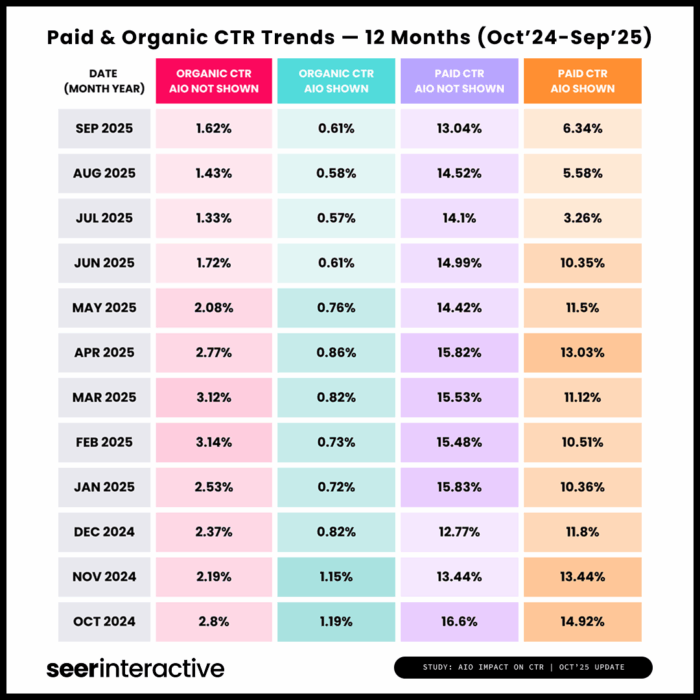
Our POV: AI Overviews function like a competitor. If your content doesn’t get pulled into the summary, discovery becomes significantly harder.
What to do next: Optimize for inclusion. Use schema, succinct summaries, and expert signals. Track performance beyond rankings. Visibility inside AI answers must become a KPI you can track through tools like Profound.
Schema’s new role in AI-driven discovery
Schema moved from a snippet enhancer to a foundational layer for machine understanding. W3C’s NLWeb group is helping standardize how AI agents consume the web.
Our POV: Schema is now infrastructure. AI agents need structured context to interpret brands, products, and expertise.
What to do next: Expand schema sitewide. Prioritize entity definitions, not just rich result templates. Add relationships between key content pieces to help machines map authority.
Paid Media & Automation
Platforms are folding more automation into ad delivery. Control now comes from strategy, not settings.
Google adds Waze to PMax
PMax can now serve location-targeted ads inside Waze for store-focused campaigns.
Our POV: This extends real-world intent targeting. For multi-location brands, Waze becomes a measurable foot-traffic lever.
What to do next: Audit store listings and geo-extensions. Monitor budget shifts once Waze impressions begin flowing. Validate whether foot-traffic lifts justify expanded proximity targeting.
Asset-level display reporting rolls out
Google Ads added per-asset reporting for Display campaigns. Marketers can now evaluate individual images, headlines, and copy.
Our POV: Better visibility helps refine creative, but it’s only part of the truth. Placement, bid strategy, and audience still determine performance.
What to do next: Organize assets with naming conventions before rollout hits your account. Use data to retire low-impact creatives and test new variants.
Meta introduces limited-spend placements
Advertisers can allocate up to five percent of budget toward excluded placements when Meta predicts performance upside.
Our POV: This creates a middle ground between strict exclusions and Advantage+ automation. It reduces risk without cutting off potential high-efficiency wins.
What to do next: A/B test manual vs. limited-spend placement setups. Evaluate cost per result and incremental conversions instead of pure CPM efficiency.
Social & Content Trends
Brands are being pushed into new storytelling styles, shaped by identity, utility, and AI-assisted behaviors.
Lifestyle branding gains momentum
Consumers are gravitating toward brands tied to identity and aspiration. Affordable luxury and status signaling are driving engagement.
Our POV: Features alone don’t move people. Identity and belonging do. If your copy focuses only on product attributes, you’re leaving impact on the table.
What to do next: Rework product messaging to show how your offering fits into a buyer’s desired lifestyle. Update CTAs, social captions, and headlines to evoke identity.
LLM-briefed CTAs redefine engagement
CXL tested CTAs that include a ready-made prompt for ChatGPT. Engagement improved because users received higher-quality AI outputs.
Our POV: As users ask AI to interpret brand content, shaping the question becomes part of conversion optimization.
What to do next: Experiment with prompt-style CTAs in guides, templates, and tools. Test which phrasing drives more accurate and useful AI interpretations.
Influencer partners expand beyond typical creators
Brands are leaning into unconventional creators; think niche experts, offbeat personalities, and micro-communities.
Our POV: As traditional influencer pools saturate, originality becomes a differentiator.
What to do next: Identify unexpected storytellers your competitors ignore. Prioritize people with unique voices and strong community trust over polished aesthetics.
PR, Reputation & Brand Risk
Data control, AI training, and brand representation became major flashpoints in November.
Reddit files legal action over AI scraping
Four companies allegedly scraped Reddit content through Google search results instead of its paid API. Reddit is suing.
Our POV: Reddit is a major training source for LLMs. Legal pressure will reshape how models access user-generated content.
What to do next: Monitor how your brand appears in Reddit threads. Insights from these conversations often influence AI outputs, even indirectly.
LinkedIn will use member data to train AI
LinkedIn updated its policy to allow profile content and posts to train in-house models unless users opt out.
Our POV: This raises transparency questions and could affect brand safety for professional voices.
What to do next: Review employee account settings. Update your governance policies to clarify how team-generated content may be reused.
ChatGPT reduces brand mentions
ChatGPT lowered brand references per response while elevating trusted entities like Wikipedia and Reddit.
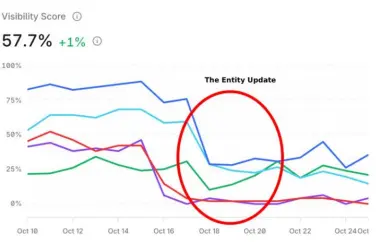
Our POV: Authority now comes from third-party validation, not just your site. If you’re missing from high-trust platforms, AI tools won’t surface you consistently.
What to do next: Strengthen your presence on Wikipedia, industry directories, and review platforms. Build citations that AI models depend on.
AI search tools mention different brands for the same queries
BrightEdge found almost zero overlap between brands recommended by Google’s AI Overview and ChatGPT.
Our POV: Each model prioritizes different signals based on its training data. Ranking in one environment doesn’t guarantee visibility in another.
What to do next: Expand Digital PR efforts beyond search. Build authority in the sources each LLM favors.
Streaming & Media Shifts
Streaming hits ninety-one percent of U.S. households
Homes now average six subscriptions and spend over one hundred dollars per month on streaming.
Our POV: Streaming is now a core channel for shaping intent long before search happens.
What to do next: Add OTT to your awareness mix. Use it to influence demand before users reach paid search or social ads.
Conclusion
AI pushed every channel toward greater automation, heavier reliance on structure, and stricter expectations for authority. Success now depends on clarity, credibility, and presence across platforms that train and inform AI, not just traditional search engines.
Brands that adapt their data, content, and distribution strategies now will stay visible as user behavior shifts.
Need help applying these insights? Talk to the NP Digital team. We’re already working with brands to navigate these changes and rebuild visibility in an AI-first world.