
AI is reshaping how marketers work, how stacks are built and how customers make decisions. To understand where these shifts are happening, Scott Brinker and I ran the AI Context Engineering in Marketing Survey (n=103, October 2025). We identified three key actions that every marketing and martech leader needs to master now.
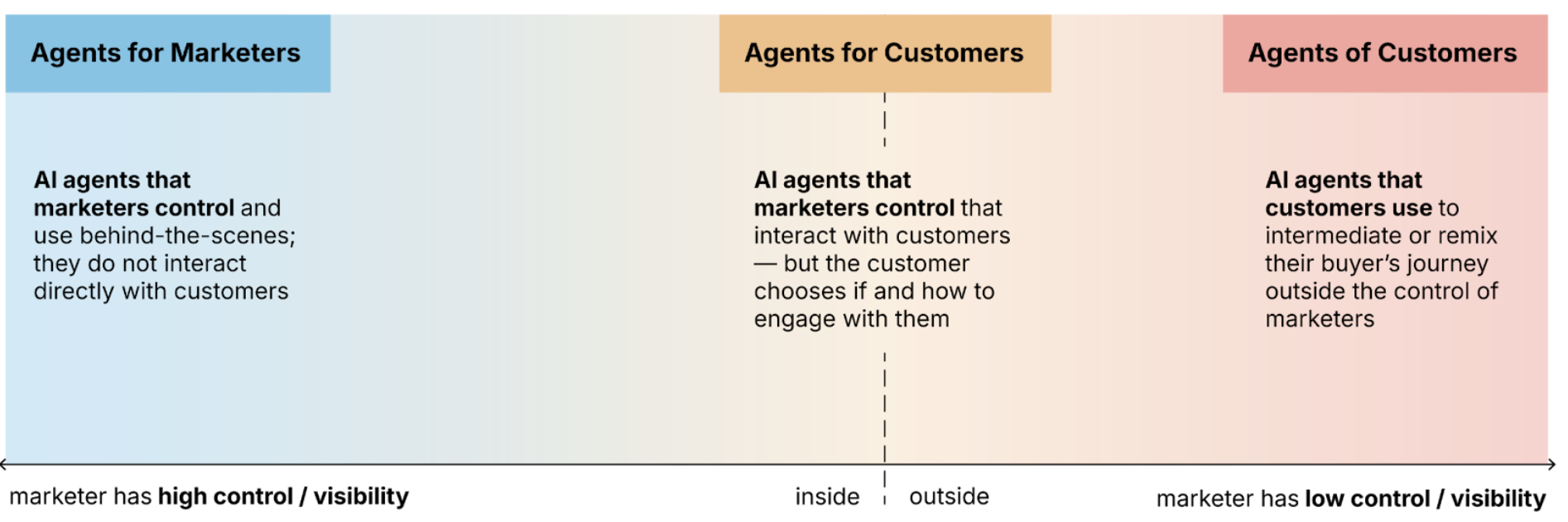
- Embrace three agent domains: Marketers are already working with a growing mix of Agents for Marketers, Agents for Customers and Agents of Customers, each reshaping the customer journey in different ways.
- Compose hybrid stacks: Stacks are evolving into hybrid systems that blend deterministic SaaS with probabilistic AI. Integrating data, context and language-based intelligence is becoming essential for a complete customer view.
- Be the change agent: Technology alone does not create value. Marketers must shift from a mindset of efficiency to one of effectiveness, using AI to enhance creativity, decision-making and new possibilities.
Together, these themes outline how AI is transforming modern marketing and what leaders must do next to stay ahead.
Three AI agents serve different purposes
90.3 % of participants say they use AI agents somewhere in their stack. It is safe to say: AI agents in martech are no longer experimental.
They are showing up across the ecosystem and you can categorize them in many ways, from the underlying technology to their speed and depth of reasoning. But at the end of the day, AI agents are tools designed to serve people. The most helpful way to understand them is to ask a simple question: Who do they work for? Who do they benefit?
Dig deeper: How agentic AI is changing the future of marketing
When viewed through this lens, the interaction between marketers and customers reveals three distinct domains.
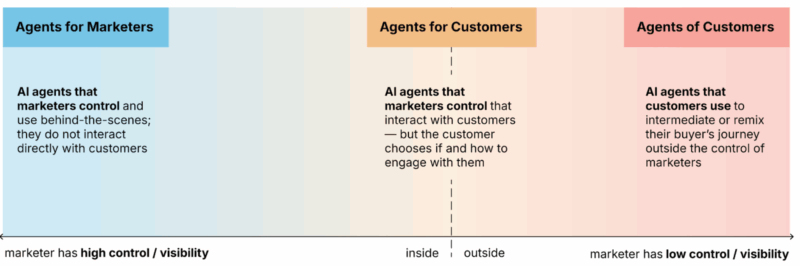
- Agents for Marketers are designed for marketers and used by them to enhance daily workflow, boost team efficiency and expedite content and campaign execution.
- Agents for Customers interact directly with customers, but marketers still set the instructions, rules and guardrails that shape their behavior.
- Agents of Customers, a new category, are entirely outside the marketer’s control. They are operated by customers and guide their journey on their own terms, from research to evaluation to decision-making.
Based on our survey data, Agents for Marketers are the most widely deployed, with organizations using an average of 3.5 of them. Companies are more cautious with Agents for Customers, putting an average of 1.71 into use. And even though Agents of Customers operate outside the marketer’s control, organizations still have an average of 1.46 tools or tactics in place to serve or influence these buyer-side agents.
If we step back, we can see how agents rank by order of adoption for all agent types and use cases we studied.

- Content production agents lead by a wide margin. 68.9% of respondents use this Agent for Marketers. Brainstorming, producing and personalizing content formed the first significant wave of generative AI use cases in marketing and they remain the easiest to run with a human reviewing the output. No surprise these use cases are the most prevalent.
- Customer service chatbot agents (Agent for Customers) come next. 54.4% of survey participants use chatbots on their website or inside mobile apps. Beyond customer service, adoption of other Agents for Customers drops off sharply.
- Agents of Customers are the true source of disruption in this new era. Buyers are increasingly turning to AI assistants such as ChatGPT, Claude, Gemini and Perplexity to research and evaluate products. A new discipline is emerging: AEO — AI Engine Optimization or Answer Engine Optimization, sometimes referred to as GEO or Generative Engine Optimization. The practices are still early. In our survey, the only widely adopted tactic was publishing AI-optimized content at 63.1%. Yet, only 13.6% reported measuring AI inclusion rate or agent-referred conversions!
Dig deeper: Martech stacks evolve through capabilities, not tools
Compose hybrid stacks
With 90.3% of participants using AI agents somewhere in their stack, the next question is how to integrate them effectively. A stack is a collection of tools and those tools are the habitat for customer data. Their job is to let that data flow, connect and form a coherent understanding of the customer.
AI agents depend on that data. To deliver real value, they must collaborate with all the tools in the stack so they can access the context surrounding each data point. This shifts stack design. Managing tomorrow’s stack means balancing deterministic, rule-based SaaS with probabilistic, language-based AI. Integration is no longer optional. The real challenge is how AI connects to the various data types and sources across the organization.
Already, 37.9% of companies are integrating AI agents directly with their cloud data warehouse or lakehouse. But a warehouse is only the starting point. Stacks contain numerous internal sources that supply the context agents need to form a comprehensive view of the customer. For example, a slight drop in product usage means very little in isolation. When connected with support tickets, call transcripts, campaign engagement or knowledge-base interactions, the picture becomes clearer. Is the customer stuck? Frustrated? Evaluating alternatives? AI can only answer those questions when it has access to the surrounding signals.
This is why the most common internal data sources connected to AI agents today are the ones that carry the richest context: customer profiles from a CRM or CDP (61.2%) and brand or marketing assets from a DAM or CMS (also 61.2%). These two sources anchor the two key jobs of any agentic workflow: understanding the customer and speaking back to the customer with the right message.

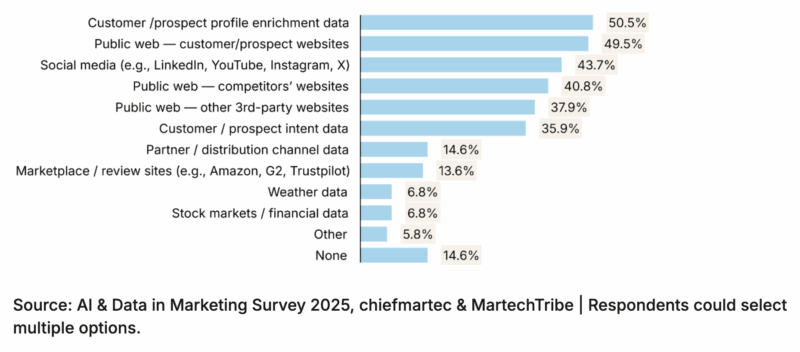
AI also enables the extraction of context from sources outside of the stack. Companies are increasingly complementing internal sources with external, unstructured data. The most common examples include third-party customer or prospect enrichment data (50.5%), customer and prospect websites (49.5%) and activity across social platforms such as LinkedIn, YouTube, Instagram and X (43.7%).
These signals are especially valuable in B2B, where buying journeys are long, distributed and often opaque. However, we are also seeing spillover into B2C, supported by the growing use of external intent signals (35.9%).
Become the change agent!
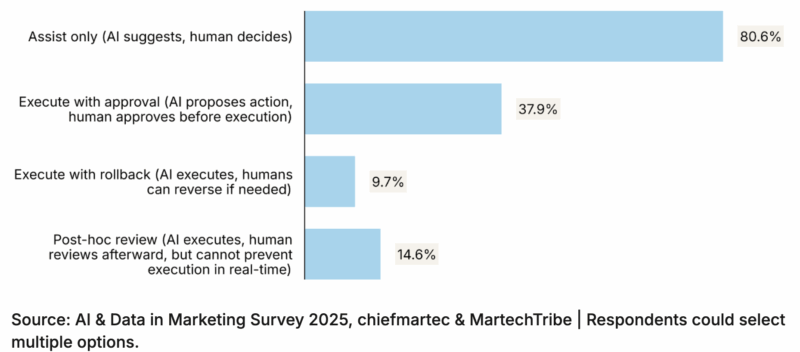
Although the word agent suggests autonomy, in all the cases we researched, there are humans-in-the-loop to decide, approve, reverse or review. That brings us to the fourth type of agent, the change agent. You.
As change agents, we need to shift our mindset from saving time to creating value. In simple terms, change from efficiency (only) to effectiveness.
- Efficiency: Do more with less. Optimize what already exists.
- Effectiveness: Do better with more. Reimagine what is possible.
Many companies are chasing efficiency, essentially digital labour arbitrage, using AI to cut costs and boost short-term earnings. However, the long-term winners will focus on effectiveness or digital labor augmentation, utilizing AI to amplify human creativity, context and decision-making. That is where durable value is created.
Think of it this way.
- Efficiency gives you speed.
- Effectiveness gives you direction.
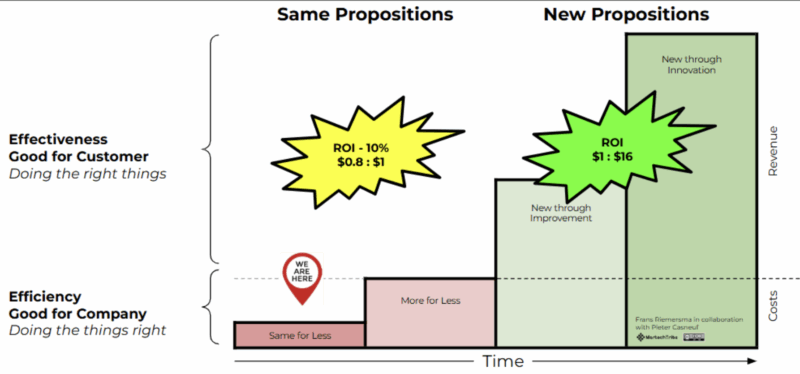
You can automate yourself into a dead end if you never stop to ask whether you’re still solving the right problem. The promise of AI isn’t productivity alone. It’s a possibility.
The shift from efficiency to effectiveness transforms AI from a cost-saving tool into a growth engine, not only improving operations but also reinventing offerings, customers and markets. The real return on AI starts when you stop counting saved minutes and start counting new opportunities. Your imagination is the only limitation.
Dig deeper: ABM isn’t the B2B salvation we were promised
When the Wright brothers built the first airplanes, they had no idea they were paving the way for airports, catering services, luggage handling, cabin crew jobs and air-cargo carriers. Yet those industries emerged because the core breakthrough created room for new value to form around it.
Imagine what AI can do for your customers and step into the role of change agent within your company.
Fuel up with free marketing insights.
Email:
MktoForms2.loadForm(“https://app-sj02.marketo.com”, “727-ZQE-044”, 16293, function(form) {
// form.onSubmit(function(){
// });
// form.onSuccess(function (values, followUpUrl) {
// });
});
The post Three actions you must take to thrive in the agentic era of marketing appeared first on MarTech.